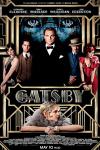
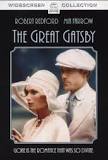
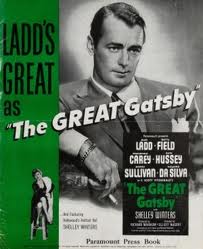
Four versions of Gatsby – from Alan Ladd to Leo DiCaprio…there was even a silent version with Warner Baxter as Gatsby, but interestingly, William Powell as Wilson.
Other interesting trivia?
John Farrow was signed to direct the 1949 Alan Ladd version, but backed out and Jack Clayton directed. John Farrow is, of course, Mia’s Dad. Mia was Daisy in the ’74 version. Howard Da Silva, who was Ben Franklin in 1776, played Wilson in the ’49 version, and then was Meyer Wolfsheim in the ’74 version.
Other interesting notes: Scott Wilson played Wilson (ha ha) in the ’74 version. Scott also played one of the killers, Dick Hickok, in the film In Cold Blood released in 1967. Guess that role didn’t raise his career capital very much, as Wilson is a relatively minor role in TGG. But is it a minor role? After all, Wilson is the guy who kills Gatsby in the end. He actually gets a little more screen time than his successor, Jason Clarke. Jason is an Aussie who never plays Aussie. The last time we saw him he was the ‘extractor of intel’ in Zero Dark Thirty. Notice I neglected to label him ‘torturer’. Refer to previous blog on that topic!
More trivia: 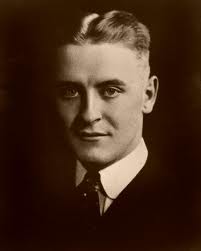 Francis Scott Fitzgerald wrote the novel TGG;
 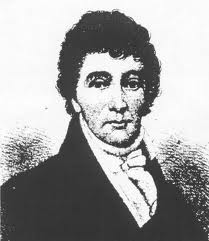 Francis Scott Key wrote The Star Spangled Banner, which did not become our national anthem until
1931. 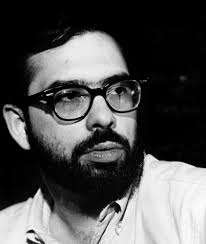 Francis Ford Coppola, of Apocalypse Now fame, wrote the screenplay for the ’74 version of TGG, after he’d become a household name for directing The Godfather in 1972.
 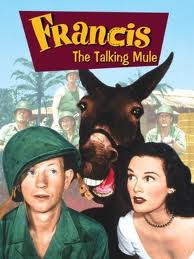 Francis the talking mule didn’t write anything, but he did talk. Isn’t that good enough for an equine?
So enough with the trivia – who cares, right? It’s trivial…
OK, let’s not dither: the big question that must be asked and answered: how likely is it a man would work so hard and then give up so much simply for the love of a woman? But was it love, or was it an overwhelming need to possess?
And what was it he wanted to possess – the person or the idea?
If you Google “Analysis of TGG” or “Evaluation of TGG” or similar words, you will get a zillion hits more than happy to give you an analysis of the story. Since it is a classic and has all those classic themes in it – FSF knew what he was doing – you can read what FSF intended from a dozen different angles. But will it really capture the essence of what this is about? Ladies, have you ever known any man like Jay? I surely have not. But maybe I’m not the woman Daisy was. Or Zelda Fitzgerald was, since there are obvious comparisons between Daisy and the real Zelda.
But I’m going way out on a limb here with a take on the character out of the mainstream, so get ready. What really drove Jay to these extremes?
OK, first a step back. If you’ve seen both versions – the ’74 and the current version – you get a slightly different story and a different level of passion/obsession from the actor playing Jay. There really wasn’t much chemistry between Redford and Farrow, and since the film editor was clearly in love with both of them, there’s entirely too much dwelling on their respective, lovely blue eyes staring at one another. So to obtain this insight, I had to juxtapose both portrayals alongside the real Jay – the author, FSF. And what do you get? A man deeply out of his element – a WASP-ish Truman Capote. I’d argue Scott Fitzgerald – despite his marriage and affair with Sheilah Grahame in his Hollywood days – was a closet gay. Jay’s obsession with Daisy has nothing to do with a man/woman love affair – they just never happen that way! I see Daisy as a metaphor for an unrequited love that FSF could never explore in his lifetime. A love affair with a man.
Why do I come to this conclusion?
I’m thinking that Nick Carraway – the aloof narrator – was gay and in love with Gatsby. So in some ways it seems Nick and Jay are two sides of the same individual – FSF himself. The alcoholism, stormy relationship with Zelda, close relationship with Hemingway – all things point to the conclusion that he was gay. OK, having stated this conclusion, what of it?
FSF was a lapsed Catholic, and we know about the guilt trips inherent in that, even if you’re straight. As famous as he was, he never really made much money – TGG was not considered a classic until after his death. No money, an expensive, ill wife and guilt over ‘inapt’ feelings would drive any man to become a roaring alcoholic, yes? I think it was Wilson’s comment toward the end of the story – after he finds out that something ‘funny’ is going on with Myrtle, his wife – he says “God is watching and he sees all”. The quote seems totally out of context for what we know about the character, before and after. I think it’s a clue to FSF’s personal struggles with his sexuality. But I seem to be the only one that sees it. Oh well…
Post Script: Maybe somebody else saw the same thing: a guy named Greg Olear, an adjunct literature professor. He goes so far as to agree with my assessment about Nick, but draws the line at saying Nick is FSF. Even tho’ in the beginning of his essay – reproduced in the on-line magazine Salon – he notes the similarities between FSF and Nick’s backgrounds. And his opinion comes from having read the novel multiple times – hey – maybe I need to add it to my book list, eh? Break from book club and Gen-X…oh my..