

257 members of the House of Representatives voted last night around 11:05 PM to pass the Senate-generated bill to avoid the fiscal cliff. John Boehner voted for it. Eric Cantor did not. It really wasn’t Over, so dead Roy can go back into the crypt.
The new package avoids the tax increases, and punts on sequestration (the significant military and defense spending cuts set to kick in today) for two months.
But something significant happened. They managed to come together and do something. The Republicans are beginning to get it, Cantor & Rubio notwithstanding. They’ll come around soon, or perish in those same ashes from which the baby phoenix arises … but enough of waxing poetic.
Let’s get back to the world situation, now that our petty politics are behind us – at least for the rest of this week while the 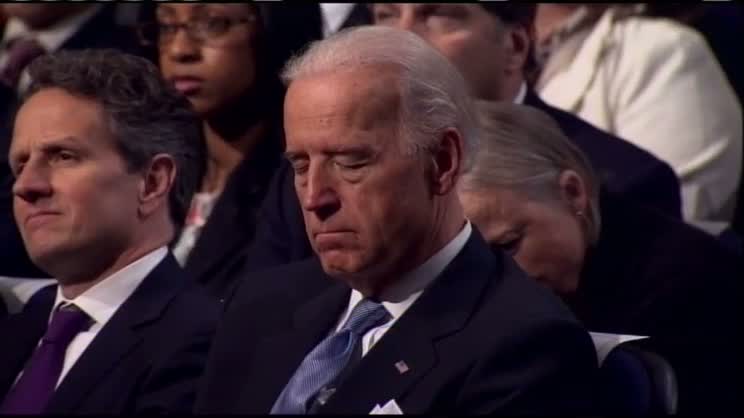 Elected go sleep this drama off.
My old friend  Ambrose Evans-Pritchard is back, with a couple of really good articles in the Daily Telegraph. I’d put the links here, but come on – does anybody even bother to cut & paste ’em to see the text, rather than taking my word for it? You know you don’t!
So I’ll just give you the titles and then we’ll talk..
Japan plans ‘nationalisation’ of factories
Stocks to soar as world money catches fire, Calvinst Europe left behind
So what’s it all about, Alfie? Let’s talk Japan first. We’ll talk about Europe tomorrow, as I must not tax your attention span.
Recall those posts of August & September talking about the effect of all that currency devaluation going on – by us, by China, and by Europe? Further recall that the devaluations in Europe and the U.S. were a function of our economic and political woes, whilst China’s was a function of trying to extend the run of their path to the middle class trap? Yeah, yeah, you say – what of it? Get to it, gal!
OK…here’s the deal. The new Japanese Prime Minister (really a recycled one from a couple years’ back, but this time he’s different!) 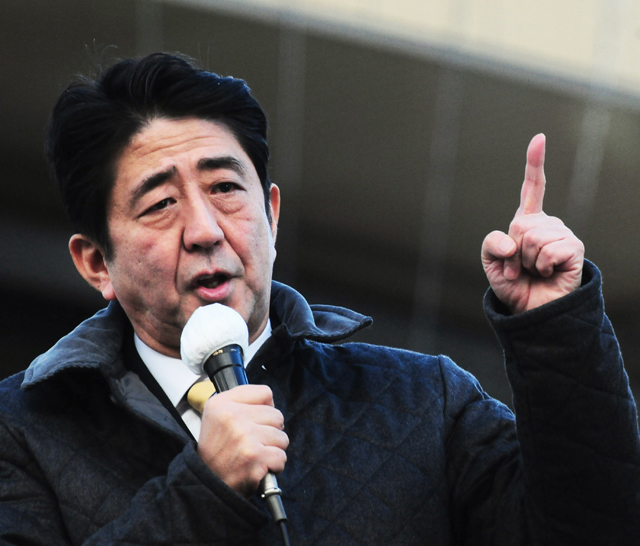 Shenzo Abe is about to spend 1 trillion yen (the equivalent of over $115 billion) buying up manufacturing capacity in Japan, and then leasing it back to business. To what end? Think China. Again recall the blog post about China’s subsidies of the solar industry in that country, effectively reducing the cost to world-wide consumers by 50%, but bankrupting Solyndra in the process? It appears that Japan is going to use its money to accomplish the same end. One of the byproducts of this action is an attempt to devalue the yen – currently at 87 to the dollar with a goal of 90 to the dollar. This makes their exports more attractive, because it lowers the cost. So don’t run out and buy that new Honda yet – if his strategy works the cost of a new Civic will come down by a bit this coming year.
So this is the chickens coming to roost (Oh, my – back to the damn birds!). And which chickens are those? Ben Bernanke’s QE-infinity chickens, that have devalued the dollar on the world market. Who’d a thunk that Japan would be the first to acknowledge & address what we’ve been doing for over two years? Here’s the quote from Shenzo:
“Foreign countries have no right to lecture us,” he said, accusing the West of failing to abide by a G20 pledge in 2009 to forgo competitive devaluations.
He’s talking about us. Now helicopter Ben has always denied that devaluing the dollar was the primary goal, and I believe him. He’s a scholar specializing in the Great Depression, and he knows the way to dig yourself out of a deflationary spiral is to flood the market with greenbacks. But oops – everybody else is beginning to see the light as well. Well, not everybody..but we’ll get to Europe tomorrow.
Back to Japan and the first article…the question that must be plaguing you at the moment is this: if it was this easy, how come Japan hasn’t done this before?
Andy Xie, a wunderkind writer for China’s Caixin Online, explains: Japanese politicians have kept their biggest demographic group happy for the past few years. Which group is that? The 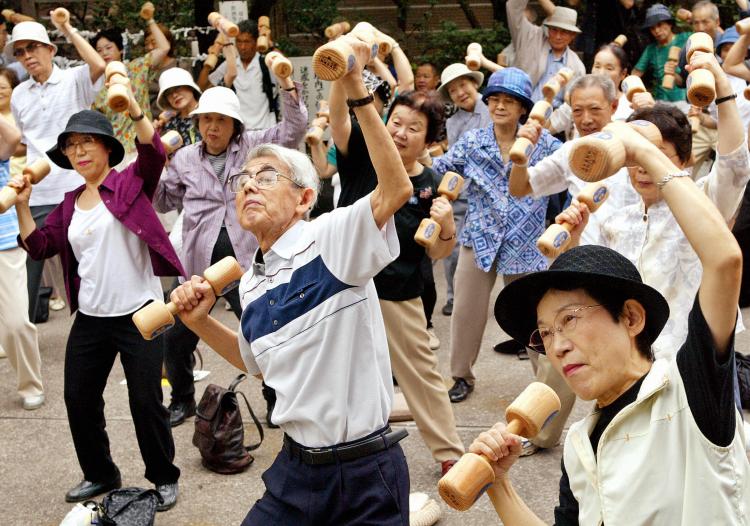 elderly. Well, actually, Japanese baby boomers. The post- World War II babies. The ones that have partially financed the massive expenditures the Japanese government has made to try to spend their way out of deflation with their savings. Deflation makes their money go further. So why change now? Because they’re now old enough to retire, and they’re starting to spend their savings. So? Japan is going to have to borrow from the outside world, versus their own people. As such, they have to worry about becoming the next Spain or Greece if borrowing costs increase because of their
 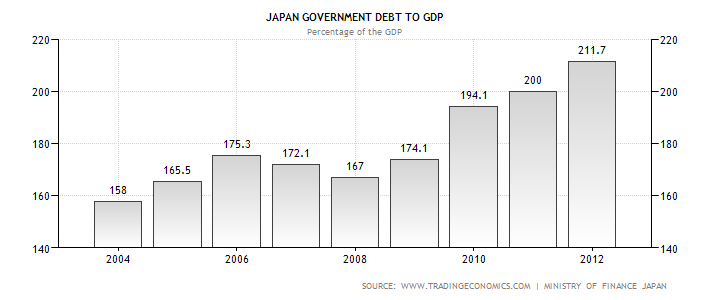 debt to GDP ratio. Just for comparison purposes, ours is about half that. Oh, Ollie, you’ve done it now. This is getting way too complex for my taste!
OK, never mind. Here’s the point – Japanese banks own a ton of Japanese government debt. The problem with Abe’s plan is that a devalued yen will make all those deflationary bonds worth less, with a potential run on the bank. That’ll be interesting to watch. Cast your eyes East for a bit, ya’ll…it’s fixin’ to get interesting.
I’m done..for now…