
(The Zika mosquito)…
Well, let’s start with things economic. The stock market continues its slow, 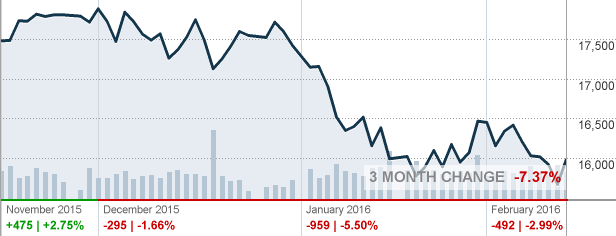 downward descent, caused mainly by investors’ correlation between the decrease in oil prices and the world economy. But is there causation or mere correlation? I’d argue there’s only correlation. Let’s discuss.
Start simple. Where are the five biggest oil producers? They are (in order from biggest down):
The U.S. (we passed Saudi Arabia in 2014 as the world’s largest, thanks to fracking)
Saudi Arabia
Russia
China (!)
Canada
Here is each country’s cost of production, measured in $/barrel, in order from lowest to highest:
Saudi Arabia $9.90
Russia $17.20
China $29.90
U.S. $36.20
Canada $41.00
Average: $26.84
So Saudi Arabia comes in nearly 3 times cheaper than the average. At current reserve estimates, they have about 90 years of oil left, given current export rates. So Saudi Arabia is betting that they can drive the competition out of business by flooding the market with oil. Seems like a logical step, eh?
But – yes, there’s always a but – They might get Canada, China and the U.S. to run the numbers and curtail production, but can  Russia afford to do that, what with being under sanctions and having a ruble that loses value by the day? Half the government’s revenue comes from oil. It’s military budget has ramped up, with expenditures in Syria now adding up to $4 million a day for its
 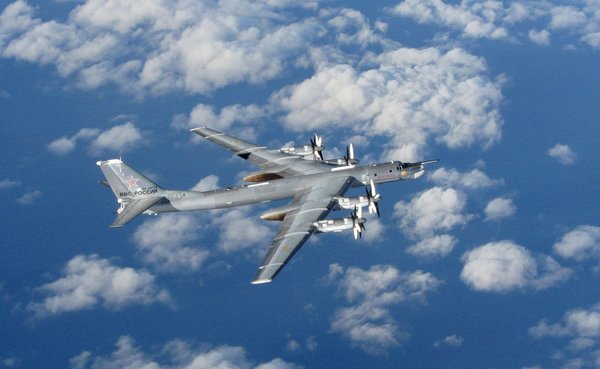 bomb strikes against the regime’s opposition. But even at $30 a barrel, the Russians are still making money, although significantly less than when oil was selling at $100 a barrel. But how long can this go on? Every day there are ‘rumors’ of OPEC cuts. Do you see any middle east country other than Saudi Arabia in that list of the top 5? No. So if, say the
 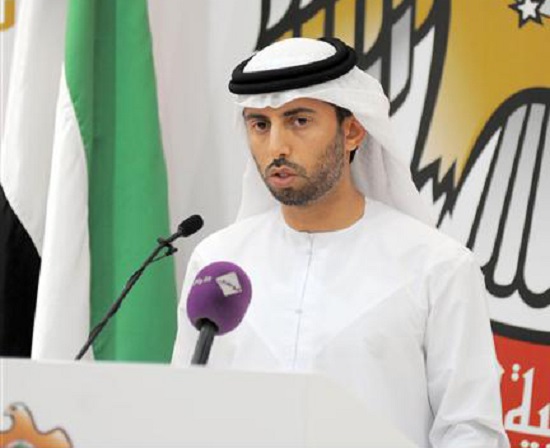 UAE – the latest source of the rumor – cuts production, it just means more room for the others to increase their production. So the name of the game is market share. If there’s always more than enough to go around, one or two smaller producers can cut production, and it won’t change the market dynamics. I expect to see oil at or below $30 a barrel for years to come – as long as there are countries left that will fill the void. Enjoy the budget boost. But one should not assume the decrease in oil prices has anything to do with the shape of the world economy. It dun’t (with a nod to Ricky Ricardo).
Next topic: Syria. Despite the skepticism, there was an announcement yesterday of a proposed cease fire in Syria to allow for humanitarian aid to be delivered to the beleaguered city of Aleppo. Go to google maps and see what it looks like today, versus five years ago. OK – here are the pictures.
Aleppo in 2010: 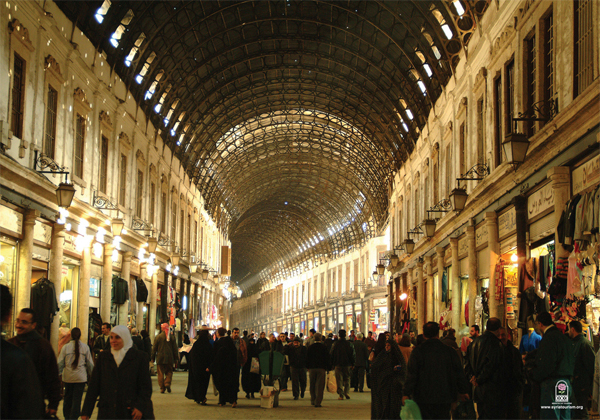
Aleppo in 2010 was was a thriving city, concerned about such things are preservation of antiquities and urban planning. Syrians were happy to shop and welcome tourists to their city, without fear of bombs falling out of the sky from a variety of sources. But then came the so-called ‘civil war’, and Aleppo changed rather considerably.
Aleppo last week:
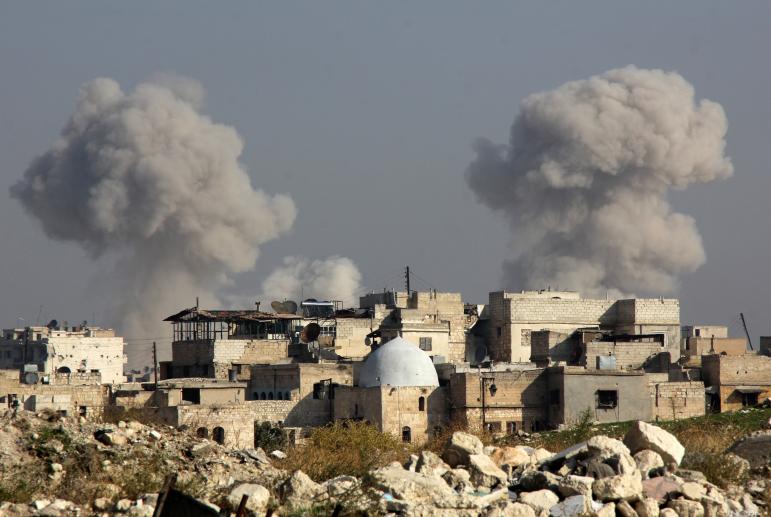
Glad you don’t live there? Aya. But here’s the thing – the neocon wing of the Republican party advocates for ramped up military intervention in Syria. Last November, all the major Republican candidates advocated for ground troops to be dispatched to Syria – and that’s what would happen to them…they’d be dispatched (look it up – it means killed). The Russians aren’t fighting ISIS – they’re fighting the so-called 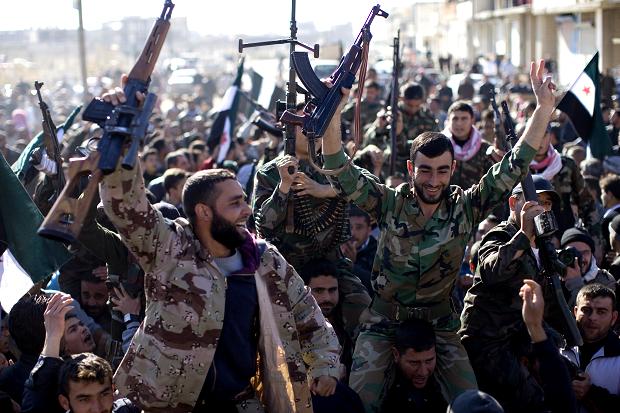 Free Syrian Army to get Assad his country back. So our role in this is … what? Let’s send troops to fight against whom? Gets real complicated real fast. In fact, Adam Garfinkle of The American Interest put forth a very interesting – and hopefully implausible – scenario for the Syrian conflict:
“What if, just to toss out one scenario, the Assad regime with the Russians look to actually win the civil war, and what if they are then willing, for their own reasons, to empower the Kurds for use as leverage against the Turks? What if, too, it were to be revealed that the Russians were secretly aiding and arming PKK cadres inside Turkey, perhaps through both PYD and Chechen intermediaries? Under such circumstances 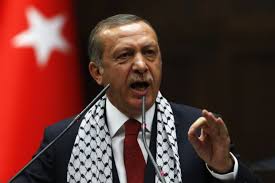 President Erdogan might believe that he has no choice but to order the Turkish military into Syria, to prevent both the fall of the north to the regime and the consolidation of PYD control adjacent to the Syrian-Turkish border. That could spark direct Turkish-Russian hostilities, and it’s hard to think of two leaders we would less like to see in a situation like that than Putin and Erdogan. That in turn could lead the Turks to invoke Article V of the
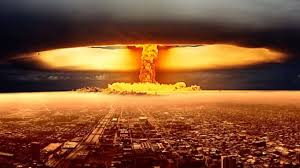
 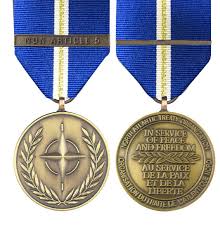 NATO treaty. Then what? We would know that coming to the aid of the Turks under such circumstances could presage a U.S.-Russian fight, and if that occurred no one could glibly rule out escalation—either horizontal escalation that could activate a front in Europe, or vertical escalation, up to and including the use of nuclear weapons. No, the Syria crisis is not directly analogous to the pre-World War I situation in Europe. But even if it shares only a single thematic feature in common, it’s enough to give one pause.”
We’d better do more than  pause. And that, gentle readers, is why we need to think twice about electing any of the current crop of Republican candidates. Be careful what you ask for
  – I know, I am repeating myself, but don’t you think something this important bears repeating? I’d say so.